

Next-Generation Baseload Energy
Power
From Lava
Transforming Earth's natural heat into reliable, scalable, around-the-clock energy infrastructure.
24/7 CLEAN POWER
Day and night. Every single day.
100% RELIABLE
Weather-proof. Always on.
CLEAN ENERGY
Near-zero emissions. Better for our planet.
BUILT FOR PEOPLE
Powering homes, businesses, and communities.
Demand Pressure
The Grid Is Being Asked To Do More Than Ever.
Artificial intelligence, electrification, manufacturing expansion, and aging infrastructure are creating a new era of electricity demand. The challenge is no longer simply producing energy. The challenge is producing reliable energy when demand occurs.
AI Compute Expansion
Training clusters and inference campuses require continuous electricity and cooling.
Electrification
Transport, buildings, and industrial systems are shifting new demand onto the grid.
Industrial Reshoring
New manufacturing footprints need dependable power, not just installed capacity.
Aging Infrastructure
Existing grids face congestion, deferred upgrades, and resilience pressure.
Chart 01
Reliability & Capacity Factor Comparison
A solar farm may be rated at 100 MW, but it only produces electricity when sunlight is available. CoreVolt is designed around continuous thermal energy, enabling reliable power generation twenty-four hours per day, seven days per week.
Reliability is the product.
CoreVolt Target
~95%
Illustrative target capacity factor pending engineering validation.
Nuclear Benchmark
~93%
Used as the familiar modern baseload comparison point.
Capacity Factor
Not All Megawatts Are Created Equal
Estimated availability in a typical year
Illustrative estimates position solar and wind well below baseload-class assets in annual availability, while CoreVolt is presented with a target profile comparable to or slightly above nuclear.
Illustrative estimates. Final values should be validated and sourced before publication.
Chart 02
Estimated Cost of Electricity Generation
Solar and wind can offer attractive generation costs but often require storage, backup generation, expanded transmission networks, and balancing infrastructure. CoreVolt's objective is to pair baseload-class reliability with a projected stable all-in cost profile.
Cheap power isn't always affordable power.
Continuous Operation Target
24 Hours
Continuous thermal operation is the design objective.
Fuel Deliveries
0 Daily
The strategic thesis removes routine fuel-chain purchasing from the operating model.
All-In Cost Structure
Cheap Power Isn't Always Affordable Power
Solar
Storage + balancing required
~78/MWh
Wind
Backup + transmission exposure
~69/MWh
Natural Gas
Fuel price and delivery exposure
~70/MWh
Nuclear
High capex, low variability
~106/MWh
CoreVolt Projection
Projected stable all-in profile
~65/MWh
The section treats generation cost and reliability cost together. In this framing, intermittent energy can start cheap but become materially more expensive once storage, backup, balancing, and transmission exposure are included.
CoreVolt line items are projection-based placeholders, not validated commercial pricing.
Investor CTA
Request A Reliability Thesis Briefing
If your decision framework is uptime, baseload quality, and long-term operating stability, the next conversation is with CoreVolt.
Chart 03
Land Use Comparison
Solar and wind require large land footprints because the energy source is diffuse and weather dependent. CoreVolt is designed around concentrated underground thermal energy, allowing the surface facility to remain comparatively compact.
More Power. Less Sprawl.
Surface Posture
Compact
Positioned as a concentrated facility rather than a sprawling field.
Strategic Lens
Land Efficient
Energy density and land efficiency shape real-world infrastructure value.
Surface Footprint
More Power. Less Sprawl.
Solar
Large distributed field
100
Extensive surface sprawl
Wind
Broad turbine spacing
78
Wide siting envelope
Natural Gas
Compact plant
22
Fuel infrastructure required
CoreVolt Target
Compact surface plant
14
Designed around concentrated heat
The visual compares relative footprint rather than claiming a final acre-for-acre equivalence. CoreVolt is framed as a compact surface plant with a much smaller surface envelope than diffuse renewable buildouts.
Chart 04
Lifecycle Emissions Comparison
Reducing emissions is critical, but emissions alone do not solve the world's energy challenge. Modern societies still require industrial-scale output, grid stability, and continuous availability.
Clean energy must also be reliable.
Positioning
Low-Emission Potential
Lifecycle framing is intentionally cautious and avoids unsupported zero-emission claims.
Mission
All Three
Affordable, reliable, and clean is the intended intersection.
Lifecycle Emissions
Clean Energy Must Also Be Reliable
Coal
Natural Gas
Solar
Wind
Nuclear
CoreVolt Target
Energy Trilemma
CoreVolt's mission is to deliver all three simultaneously, while clearly labeling final emissions outcomes as design objectives pending validation.
Coal and gas remain the highest-emissions references. CoreVolt is positioned as a low-emission potential system, but the chart explicitly keeps that language provisional pending lifecycle validation.
Illustrative lifecycle values and CoreVolt targets require final sourcing before publication.
Chart 05
Construction Timeline Comparison
Global electricity demand is accelerating faster than most long-cycle generation can be built. CoreVolt's objective is to offer utility-scale baseload generation with a timeline materially faster than traditional nuclear delivery.
The world cannot wait 10 years.
CoreVolt Target
3-5 Years
Target delivery window used for comparative planning discussions.
Nuclear Benchmark
8-12 Years
Used here as the long-cycle infrastructure comparison.
Delivery Timeline
The World Cannot Wait 10 Years
The chart contrasts near-term solar and wind schedules with multi-year gas builds, projected CoreVolt deployment timing, and very long nuclear delivery cycles.
Actual industry ranges and CoreVolt targets should be validated before release.
Technology Overview
An Extreme-Geothermal Infrastructure Thesis
CoreVolt is designed around a simple strategic idea: concentrated underground heat could support a compact, continuously operating power platform when paired with a serviceable transfer and conversion architecture.
Thermal Harvesting
CoreVolt is designed to access concentrated underground heat and move it into a managed conversion system.
Surface Conversion
A compact surface plant converts thermal throughput into utility-grade electric output.
Monitoring & Controls
Operational visibility, thermal management, and lifecycle planning are built into the architecture.
Provided Engineering Graphic
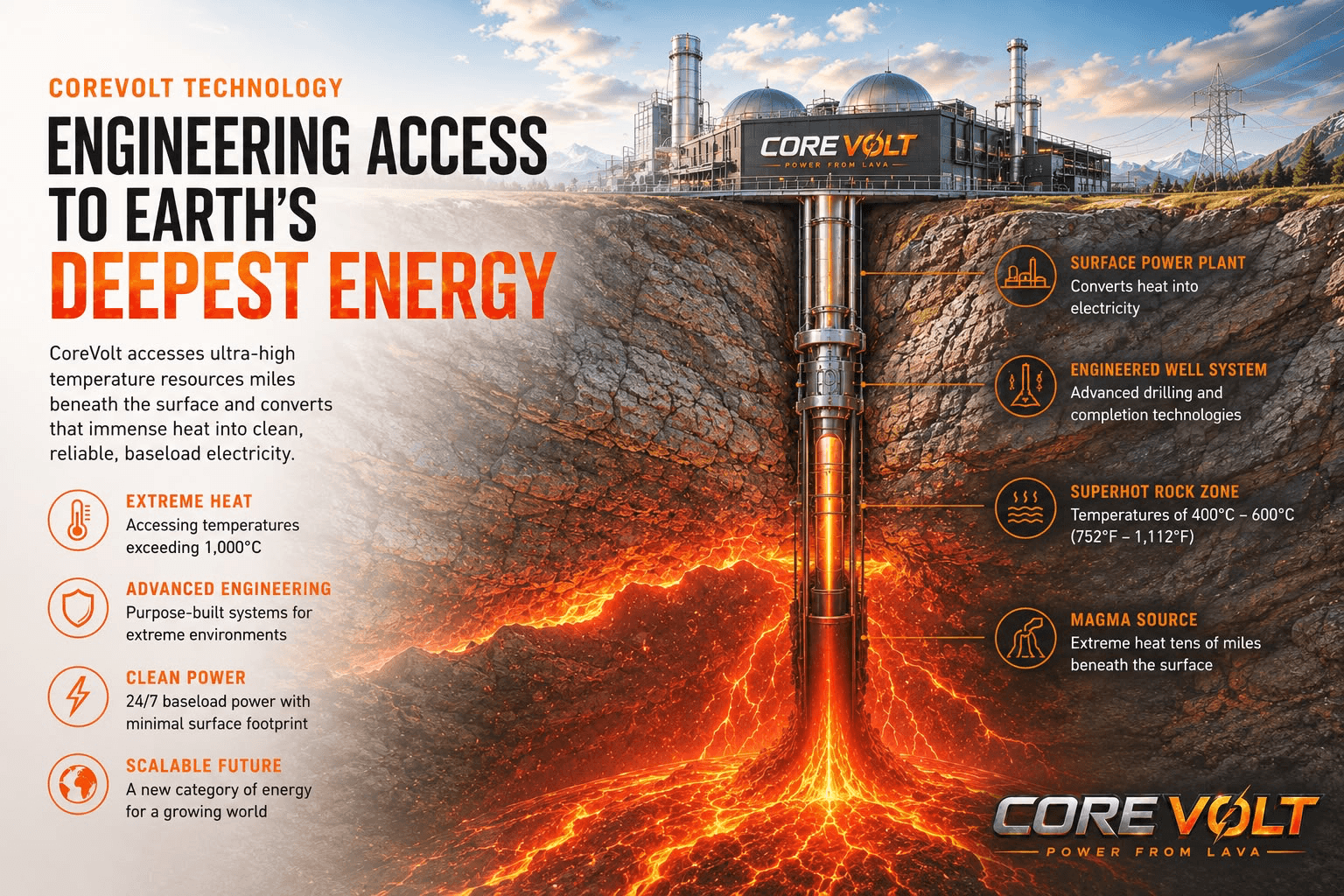
Surface Layer
The supplied image shows the surface power plant and interconnection equipment above grade.
Transfer Spine
The central well path explains how thermal energy is accessed and moved upward through the system.
Thermal Zone
The lower field visualizes the superhot subsurface resource that anchors the CoreVolt thesis.
PyraPipe™
Thermal Transfer Built Like Industrial Hardware
PyraPipe™ represents the thermal transfer architecture within the CoreVolt concept. The design language is deliberately infrastructural: monitored, modular, serviceable, and built around the movement of concentrated heat rather than chemical fuel.
Heat Path
High-temperature transfer path designed around modular deployment concepts.
Instrumentation
Instrumentation zones for pressure, thermal flux, and structural monitoring.
Service Strategy
Service philosophy focused on inspection access, predictable maintenance, and staged upgrades.
Replaceable High-Heat Interface
Inspect
Lifecycle planning designed around inspection, swap windows, and maintainability.
Service
Targeted service intervals intended to reduce whole-system replacement risk.
Replace
Replaceable thermal-contact philosophy for the most demanding operating interface.
PyraTip™
A Serviceable Interface Philosophy
PyraTip™ is positioned as the replaceable high-temperature interface within the CoreVolt concept. That serviceability narrative matters because generational infrastructure is judged not only by output, but by how deliberately it can be inspected, maintained, and upgraded over time.
Power Generation Process
How CoreVolt Works
The supplied process graphic now carries the step-by-step system explanation directly, so the section presents it without cropping or reinterpretation.
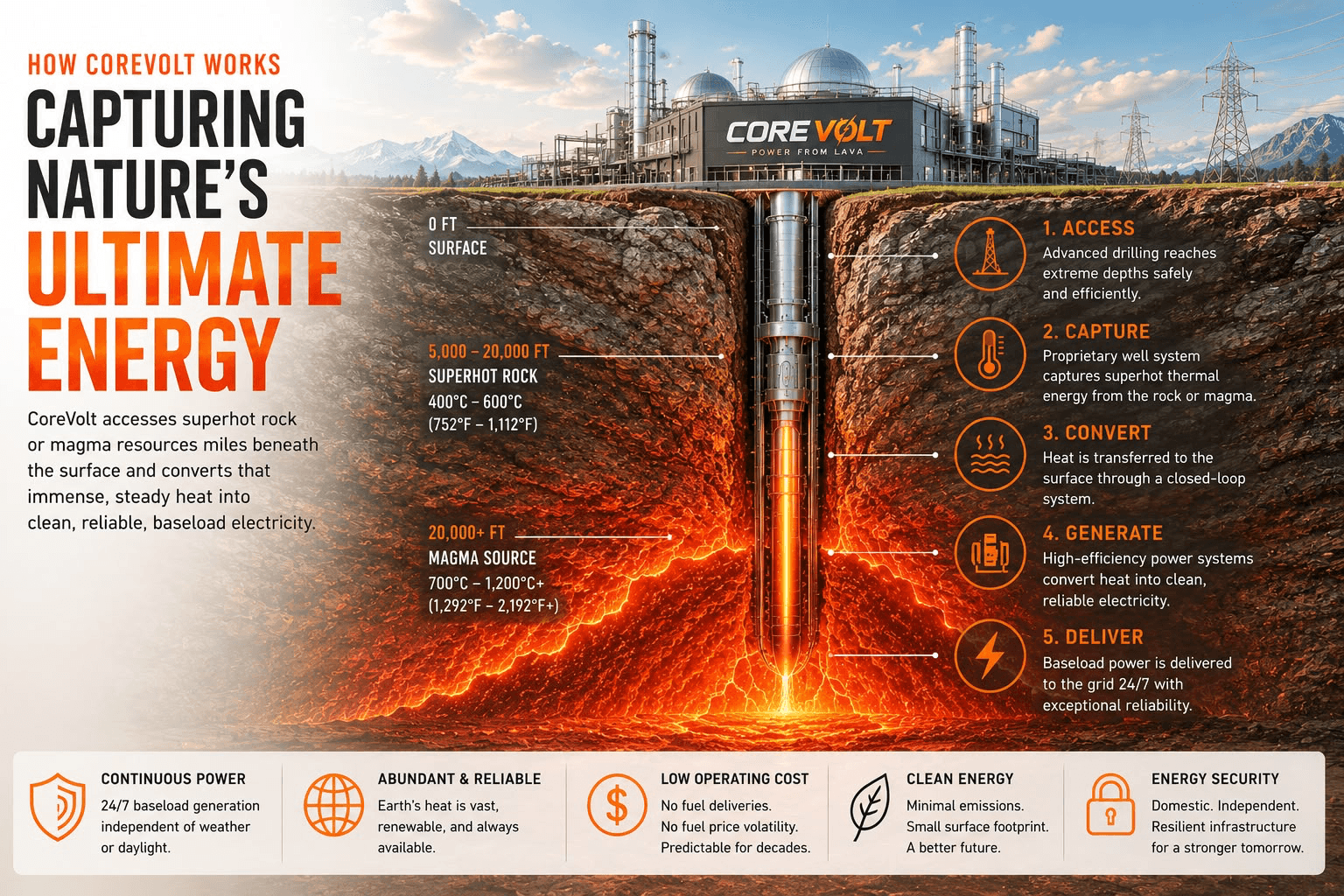
Chart 06
Energy Density Comparison
Utilities do not only need electricity. They need large amounts of electricity in a small footprint, available continuously, with minimal infrastructure expansion.
Energy density changes infrastructure economics.
CoreVolt Posture
Dense
A compact footprint changes siting, transmission, and land-use options.
Investor Lens
Utility Grade
Reliability, scalability, and density compound the infrastructure case.
Density Index
Energy Density Changes Everything
Solar
1.0x
Large sites + storage
Wind
1.6x
Broad land envelope
Natural Gas
4.4x
Compact plant + fuel chain
Nuclear
5.1x
Compact site + extensive regulation
CoreVolt Target
5.4x
Compact surface plant + thermal resource
The density index is illustrative, not a scientific equivalence claim. It shows CoreVolt positioned alongside the most compact utility-scale systems rather than the most land-intensive ones.
Partnership CTA
Evaluate The Surface Footprint Advantage
Utilities, industrial operators, and data-center developers can use the compact-siting thesis as a starting point for partnership discussions.
Chart 07
Grid Reliability Comparison
The electric grid cares about one thing: is power available when people need it? A large intermittent facility still requires additional infrastructure if it cannot produce through nighttime, storms, and seasonal shifts.
The grid values availability, not just nameplate capacity.
CoreVolt Profile
24 Hours
Designed around a steady operating target rather than a weather-shaped one.
Utility Priority
Availability
Dispatchability and predictable output increasingly dominate grid planning.
24-Hour Availability
The Grid Does Not Care About Installed Capacity
Solar
Average availability 33%
Wind
Average availability 51%
Nuclear
Average availability 94%
CoreVolt Target
Average availability 95%
The 24-hour blocks make the argument visually: solar disappears overnight, wind fluctuates, and baseload-style assets remain available through the full day.
Chart 08
Fuel Supply Dependency Comparison
Most power plants require a massive logistics operation: mines, pipelines, railcars, storage yards, processing, and commodity contracts. CoreVolt's theoretical advantage is that the heat source already exists underground.
Energy security starts with fuel security.
Daily Fuel Chain
Removed
CoreVolt's thesis reduces routine fuel-market exposure.
Strategic Advantage
Domestic Heat
The resource narrative is anchored in local thermal energy rather than delivered fuel.
Fuel Logistics
The Cheapest Fuel Is Fuel You Never Have To Buy
Mining, rail, yards, handling
Pipelines, processing, commodity markets
Fuel cycle planning and enrichment
No fuel deliveries, variable output
No fuel deliveries, daylight dependent
No daily fuel supply chain required
Logistics Comparison
Traditional Fuel Chain
- Extraction
- Transport
- Storage
- Price exposure
Underground Thermal Source
- No daily fuel deliveries
- No tank farms or railcars
- Reduced commodity exposure
- Continuous thermal thesis
Coal, gas, and nuclear all carry meaningful fuel-cycle logistics. CoreVolt is positioned with very low ongoing fuel dependency because the system is designed around in-place thermal input.
Chart 09
25-Year Operating Cost Comparison
A plant that costs less to build is not necessarily the least expensive plant to operate. Over decades, fuel purchases and logistics often exceed original construction cost.
The fuel bill never arrives.
Decision Horizon
25 Years
Infrastructure investors price total ownership, not just day-one capex.
CoreVolt Projection
Stable Curve
Projected long-run operating costs remain materially lower than fuel-exposed systems.
Cumulative 25-Year Operating Cost
Construction Cost Is Only The Beginning
Fuel-intensive assets accumulate cost much faster over time. The CoreVolt projection assumes service and maintenance costs, but not recurring fuel purchasing, which materially changes the long-run curve.
CoreVolt series reflects projected maintenance and replacement intervals, not validated commercial O&M data.
Chart 10
Energy Independence & National Security Comparison
Every major economy depends on reliable electricity. Without it, manufacturing slows, data centers go offline, communications weaken, and defense infrastructure becomes more exposed.
Energy security is national security.
Logistics Exposure
Low Target
The architecture is designed to reduce dependence on external fuel delivery systems.
Domestic Resilience
High Target
Potential future applications include strategic domestic infrastructure resilience.
National Security Lens
Energy Security Is National Security
92/100
40/100
80/100
56/100
58/100
64/100
22/100
48/100
8/100
94/100
The matrix compares logistics exposure against domestic resilience. CoreVolt is positioned at the low-exposure, high-resilience end of that map because its resource base is underground rather than delivered.
Chart 11
24-Hour Power Output Profile
Electricity demand never sleeps. The question is not simply whether electricity can be produced. The question is whether electricity can be produced when demand occurs.
The Sun sets. The wind changes. The heat below continues.
Data Center Fit
24/7
AI infrastructure needs continuous compute, cooling, networking, and power.
Revenue Lens
Always On
Every hour of availability increases utilization and grid value.
24-Hour Output
The Sun Sets. The Wind Changes. The Heat Below Continues.
Solar rises and falls, wind oscillates, and nuclear stays mostly flat. CoreVolt is shown as a near-flat target line to communicate baseload-style availability at a glance.
CoreVolt and nuclear lines are illustrative baseload profiles, not field-measured datasets.
Chart 12
100-Year Resource Longevity Comparison
Energy infrastructure decisions are not five-year decisions. They are multi-decade commitments. The strongest systems combine long asset life, stable operating behavior, and a resource base that does not expire with each delivered fuel contract.
Generational infrastructure wins the long game.
Thermal Resource Thesis
100 Years
Presented as a generational target horizon pending engineering and geology validation.
Service Model
Replaceable
Surface systems and PyraTip interfaces are framed as serviceable, not disposable.
Longevity Horizon
Built Like A Generational Infrastructure Asset
Solar + Storage
30 years
Wind
30 years
Natural Gas
40 years
Nuclear
80 years
CoreVolt Target
100 years
The timeline distinguishes resource life from service cycles. CoreVolt is positioned with a long-duration thermal resource thesis plus discrete replacement windows for serviceable components.
Resource longevity projections must be validated by engineering, geology, and thermal modeling before publication.
Applications
Built For Utility, Compute, And Strategic Infrastructure Demand
Potential future applications span utilities, data centers, military and critical infrastructure, remote communities, and industrial sites. Each application values a different mix of uptime, compactness, and long-term cost predictability.
Utilities
Designed for baseload support, grid resilience, and compact utility-scale generation.
- Capacity factor target near baseload class
- Weather-independent output thesis
- Smaller surface footprint
Data Centers
Positioned for continuous compute, cooling, and uptime-sensitive infrastructure.
- 24-hour power profile objective
- Reduced commodity fuel exposure
- Potential campus-adjacent siting
Military & Critical Infrastructure
Potential future applications include long-term resilience for strategic facilities.
- Reduced fuel logistics
- Domestic energy resilience narrative
- Continuous-power positioning
Remote Communities
Localized generation could reduce dependence on delivered fuels and fragile transmission.
- Compact surface architecture
- Lower fuel-transport burden
- Potential long-duration stability
Industrial Facilities
Heavy industry values stable output, predictable operating costs, and infrastructure longevity.
- Private-wire opportunities
- Predictable uptime positioning
- Energy-density advantage
Investor Opportunity
Positioned As A Generational Infrastructure Asset
The CoreVolt narrative combines reliability, energy security, compact land use, and long-cycle infrastructure value. The objective is not to look like a commodity energy project. It is to read like a strategic platform.
Reliability Thesis
CoreVolt's design objective is a baseload-class operating profile positioned for continuous output.
Infrastructure Thesis
The company is framed as long-cycle energy infrastructure rather than a short-life generation project.
Energy Security Thesis
Domestic underground heat could reduce dependence on commodity fuel markets and daily deliveries.
IP & Engineering Roadmap
The commercialization narrative centers on interface design, thermal transfer architecture, and operating systems.
Commercialization Roadmap
Concept validation and engineering models
Materials and thermal-interface testing
Pilot system design
Demonstration project
Utility and industrial partnerships
Initial commercial deployment
Modular expansion programs
Media Vault
Reference Assets, Hero Media, And Delivery Slots
The workspace now contains the hero reference image, looping thermal video, live logo assets, and the supplied engineering graphics, all wired into the site without changing the content structure.



Flyer / Deck
Investor Briefing Deck
Reserved panel for deck, flyer, or engineering brief uploads once those files are added to /public/assets.
FAQ
Questions Investors And Partners Will Ask
The site uses careful forward-looking language. These responses keep the positioning strong without overstating validated performance, deployment status, or final economics.
What is CoreVolt building?
CoreVolt is presented as a next-generation energy infrastructure concept designed to convert extreme geothermal heat into reliable, scalable baseload electricity.
Is CoreVolt claiming proven commercial deployment today?
No. The site intentionally uses forward-looking language such as target, projection, objective, and designed to. It avoids unsupported claims about proven deployment, final performance, or certified outcomes.
Why emphasize capacity factor and reliability so heavily?
The investment thesis depends on electricity being available when demand occurs. Capacity factor, baseload behavior, and grid availability materially affect utility value and long-term economics.
How does CoreVolt think about emissions?
The positioning focuses on low-emission potential associated with geothermal-style systems while acknowledging that final lifecycle results must be validated before publication.
Who could be a partner?
Potential future partners include utilities, industrial operators, data center developers, engineering collaborators, policymakers, and strategic infrastructure investors.
What is the role of PyraPipe and PyraTip?
PyraPipe refers to the thermal transfer architecture, while PyraTip refers to the replaceable high-temperature interface philosophy intended to improve serviceability at the hottest operating zone.
Partnership CTA
Build The Next Layer Of Energy Infrastructure
CoreVolt is seeking investor conversations, strategic partnerships, engineering collaboration, and media engagement. If you are evaluating reliable power for utilities, data centers, or industrial infrastructure, this is the conversion point.
Strategic Inquiries
Investors, utilities, policymakers, and major operators can use this channel to initiate a focused discussion.
Engineering Dialogue
The platform is designed for serious technical review, not lifestyle-brand marketing.